Trash disposal operates as one of Singapore’s most essential yet least examined systems, a vast infrastructure touching every resident multiple times daily yet remaining largely invisible to those it serves. The bin chute in your flat opens to a vertical shaft descending through dozens of floors, collecting refuse from hundreds of households before depositing everything into compactor rooms most residents never see. Understanding how trash moves through Singapore requires looking past the sanitised official accounts to examine the actual mechanics, the real costs, and the uncomfortable truths about a system operating at its limits.
The Official Framework
The National Environment Agency governs trash disposal regulations through the Environmental Public Health Act, which states: “Every person shall ensure that waste is properly stored and disposed of in accordance with prescribed methods.” This mandate creates legal obligations extending beyond simple convenience, establishing disposal as civic duty backed by enforcement and penalties.
Singapore divides waste into distinct categories, each following separate pathways:
- General waste collected three times weekly from housing estates
- Recyclables gathered fortnightly in blue bins
- Food waste requiring separate handling in pilot programmes
- Hazardous materials demanding specialised disposal procedures
- Electronic waste covered under Extended Producer Responsibility schemes
The system appears comprehensive on paper. Implementation reveals complications the official descriptions often minimise.
The Collection Reality
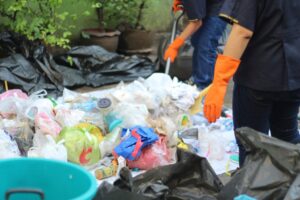
Watch the trash disposal process unfold during early morning hours, and patterns emerge that official statistics obscure. Collection crews, predominantly migrant workers earning modest wages, navigate neighbourhoods following routes mapped to military precision. They operate on schedules most residents never witness, arriving between midnight and dawn when streets remain passable.
The work involves more than driving lorries and emptying bins. Crews manage blocked chutes requiring manual clearing, contaminated recycling bins needing sorting, improperly disposed items, and equipment failures demanding field repairs. These workers constitute the invisible foundation upon which Singapore’s reputation for cleanliness rests.
Where It Actually Goes
Singapore’s trash disposal infrastructure depends entirely on four waste-to-energy incineration plants. These facilities, located at Tuas, Senoko, Tuas South, and Keppel Seghers Tuas, process nearly all the nation’s solid waste. The technology reduces volume by approximately ninety percent whilst generating electricity fed into the national grid.
The process works as follows:
- Collection lorries transport waste to incineration plants
- Refuse burns at temperatures exceeding 1,000 degrees Celsius
- Heat generates steam driving turbines producing electricity
- Ash residue undergoes further processing
- Remaining material travels by barge to Semakau Landfill
Semakau represents the endpoint, the place where Singapore’s consumption ultimately accumulates despite all the intermediate processing. This offshore facility, built by connecting two small islands, provides the only landfill space remaining. Current capacity projections suggest exhaustion around 2035, after which Singapore faces a predicament with no straightforward solution.
The Numbers Tell Stories
Official statistics document Singapore’s rubbish disposal patterns with characteristic thoroughness. Each resident generates approximately 410 kilogrammes of domestic waste annually. Nearly 7.7 million tonnes of solid waste require processing yearly, a figure that continues rising despite government campaigns promoting reduction.
The recycling rate, officially 55 percent, obscures uncomfortable details. Much derives from construction and industrial waste rather than household recycling. Domestic recycling rates remain substantially lower, hovering around 22 percent.
Contamination and Compliance
The trash disposal Singapore system depends on proper waste segregation, yet compliance remains inconsistent. Visit any estate’s recycling bins and the contamination becomes immediately apparent:
- Food waste mixed with paper recyclables
- Non-recyclable plastics placed in designated bins
- Liquid-filled containers creating hygiene hazards
- Textiles and non-approved items contaminating loads
Contamination forces entire truckloads into incineration rather than recycling, undermining the system’s environmental objectives. The National Environment Agency conducts spot checks and imposes fines, but enforcement covers only a fraction of violations.
The Cost Structure
Singapore subsidises refuse disposal Singapore heavily through general taxation. Residents pay nominal amounts through conservancy charges, but these fees cover only a fraction of actual costs. Collection services, incineration operations, landfill management, and regulatory oversight require substantial public expenditure rarely itemised transparently.
Commercial entities face different calculations. Businesses generating waste beyond residential volumes must contract private waste collectors, paying rates reflecting actual disposal costs without subsidies.
Future Constraints
The Zero Waste Masterplan sets ambitious targets: reducing waste sent to Semakau by thirty percent by 2030. Achieving this requires fundamental changes in behaviour and consumption patterns. The government promotes various initiatives:
- Extended Producer Responsibility schemes making manufacturers responsible for product disposal
- Mandatory reporting for large waste generators
- Food waste segregation programmes in selected estates
- Public education campaigns promoting waste reduction
These efforts acknowledge that current trash disposal patterns prove unsustainable. The question remains whether initiatives will achieve necessary reductions before Semakau reaches capacity.
The Unspoken Alternative
Singapore has no realistic alternative to its current system. Exporting waste to neighbouring countries carries political complications and environmental concerns. Ocean dumping violates international treaties. Building additional landfills requires land Singapore cannot spare. The only viable path involves reducing waste generation itself, a solution requiring changes in consumption patterns deeply embedded in the culture of prosperity.
Closing
The morning after any collection day, estates across Singapore awaken to empty bins and clear corridors, evidence of systems functioning as designed. Yet beneath this surface efficiency lies a more complicated reality of workers labouring in darkness, incineration plants burning constantly, and a landfill slowly filling despite all reduction efforts. Understanding trash disposal means recognising both the remarkable infrastructure making modern urban life possible and the fundamental unsustainability of patterns that infrastructure currently enables, revealing uncomfortable truths about the endpoint awaiting every society that mistakes efficient trash disposal for actual solutions.